Riding to the trail
A bike gets you to the trailhead and solves the parking. It also puts you on roads that were not built with you in mind.
There is something satisfying about leaving the car at home and riding to the start of a hike. The day opens with a warm-up, parking stops being a problem, and on a good morning the ride is half the fun. It also means mixing with traffic on roads that rarely have room for bikes, often at hours when drivers are least alert. A little preparation makes the ride as easy as the walk.
The fastest route by car is rarely the best one by bike. Roads that lead to trailheads tend to be busy on weekend mornings, and their shoulders are often narrow, broken or full of gravel.
Choosing the route
Look for a parallel county road, a bike path or a quieter back way, even if it adds a few miles. Cycling maps and the bike setting on most map apps show which roads have a shoulder, a lane or lighter traffic.
Ride the route once on a quiet day if you can. You learn where the shoulder disappears, which climbs drag on, where the rumble strips sit and where there is a gas station for water. Knowing the bad stretch is coming makes it easier to ride it well.
Being seen
Most collisions between cars and bikes happen because the driver did not see the rider in time. The answer is to give drivers as many chances to see you as possible.
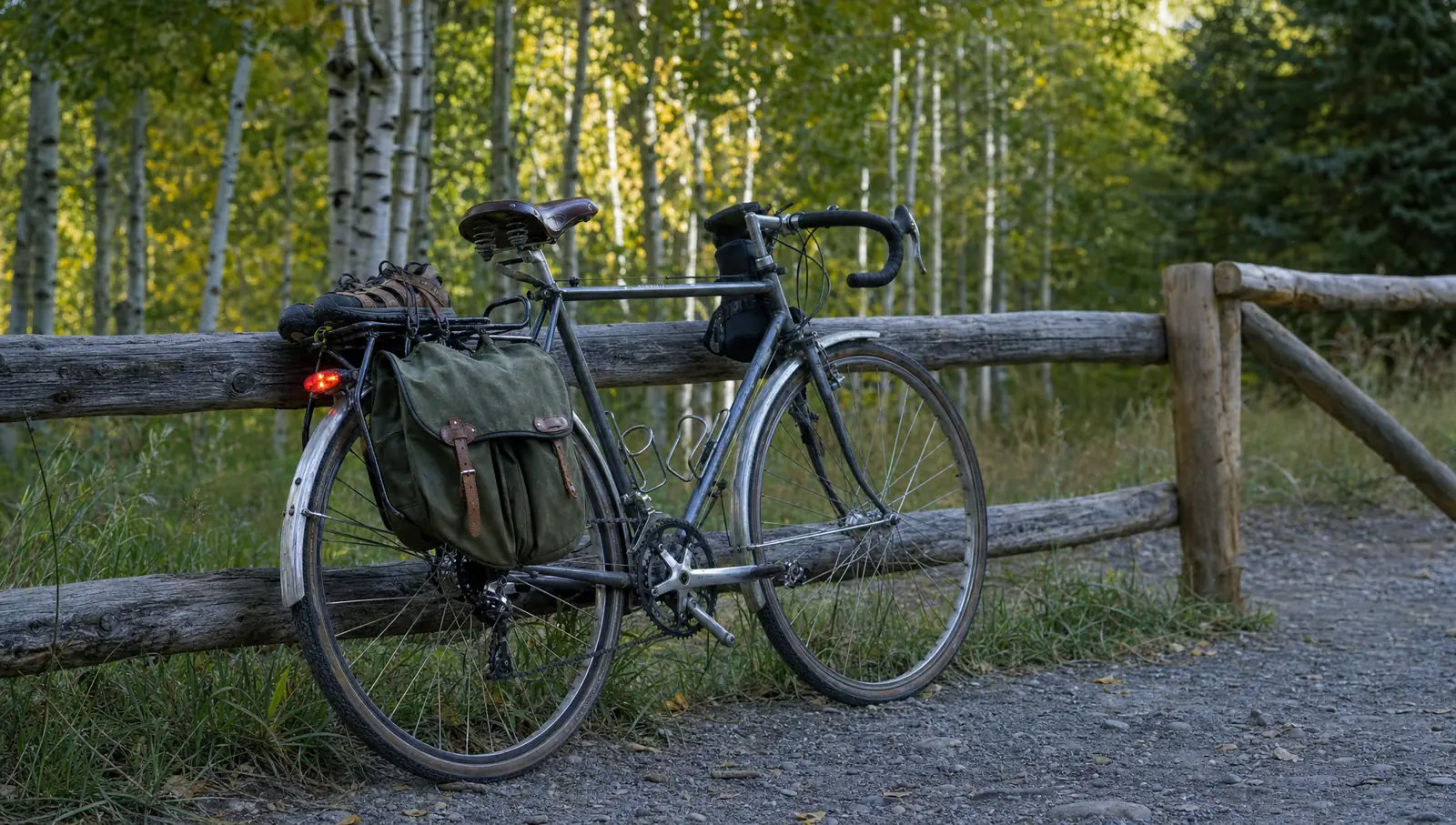
Lights help, even in daylight. A flashing rear light, visible from far back, gives drivers something to notice long before they reach you. A front light on a steady or slow flash makes you visible to drivers turning across your path. Bright clothing is a good start, though in low light it helps less than you might expect. Reflective material on moving parts, such as ankles and pedals, catches headlights better than reflective material on the torso, because movement draws the eye.
Riding with traffic
Ride in a straight line, predictably, and far enough from the edge that you are not dodging every crack and patch of gravel. Weaving along a broken shoulder surprises drivers. On narrow roads where a car cannot safely pass inside the lane, riding a little farther out discourages a squeeze pass. When a queue builds behind you, pull over briefly where it is safe and let it go by. It is courteous, and it lowers the chance of someone getting impatient.
Watch intersections and driveways closely. A driver pulling out of a side road is looking for cars and may not register a bike. When in doubt, slow down and assume they have not seen you.
Carrying the hiking gear
A small pack on your back is the simplest choice for short rides and short hikes, though it makes for a sweaty back and shifts your weight up. For anything longer, a rear rack with a pannier keeps the weight low and off your shoulders. Hiking shoes can ride strapped on top of the rack, and trekking poles collapse to fit inside the bag.
Pack so nothing dangles. A loose strap or a jacket tied around the waist can catch in the spokes or the chain, and that kind of crash happens fast. Check that everything is tight before you set off, and again after the first mile.
At the trailhead
A good lock matters more at a remote trailhead than in town, because the bike may sit alone for hours. Lock the frame to something fixed and solid, such as a rack, a post or a sturdy fence, and take the lights with you. Avoid signposts with removable signs, small trees, and anything that blocks a gate or a path. A bike in the way may be moved.
Before starting the hike, swap shoes, drink, eat something and check that the lights have enough charge for the ride home. If the hike runs long, that ride may end in dusk.
The ride home
This is where most of the risk sits. You will have walked several miles and maybe climbed a few thousand feet. Legs are heavy, reactions are slower and the light is lower. Rest before getting back on the bike. Eat something real, refill your water and put on a dry layer, because a cold rider rides stiffly.
Ride more conservatively than you did in the morning. Take the quieter route even if it is longer, and turn the lights on early. If the hike ran very late and the way home means a busy road in the dark, calling for a ride, waiting for a friend or walking the bike to somewhere better lit are all reasonable choices. Nobody hands out a prize for riding every mile.
Before you leave home
Check the tires for pressure and cuts, the brakes for bite and the chain for oil. Carry a spare tube, a pump, tire levers and a small multi-tool, and know how to use them, because a flat at a quiet trailhead with no signal is a long walk. Charge both lights, and pack a small backup light if the ride home could run late. Once it becomes routine, all of this takes about ten minutes, and the day starts and ends under your own power.