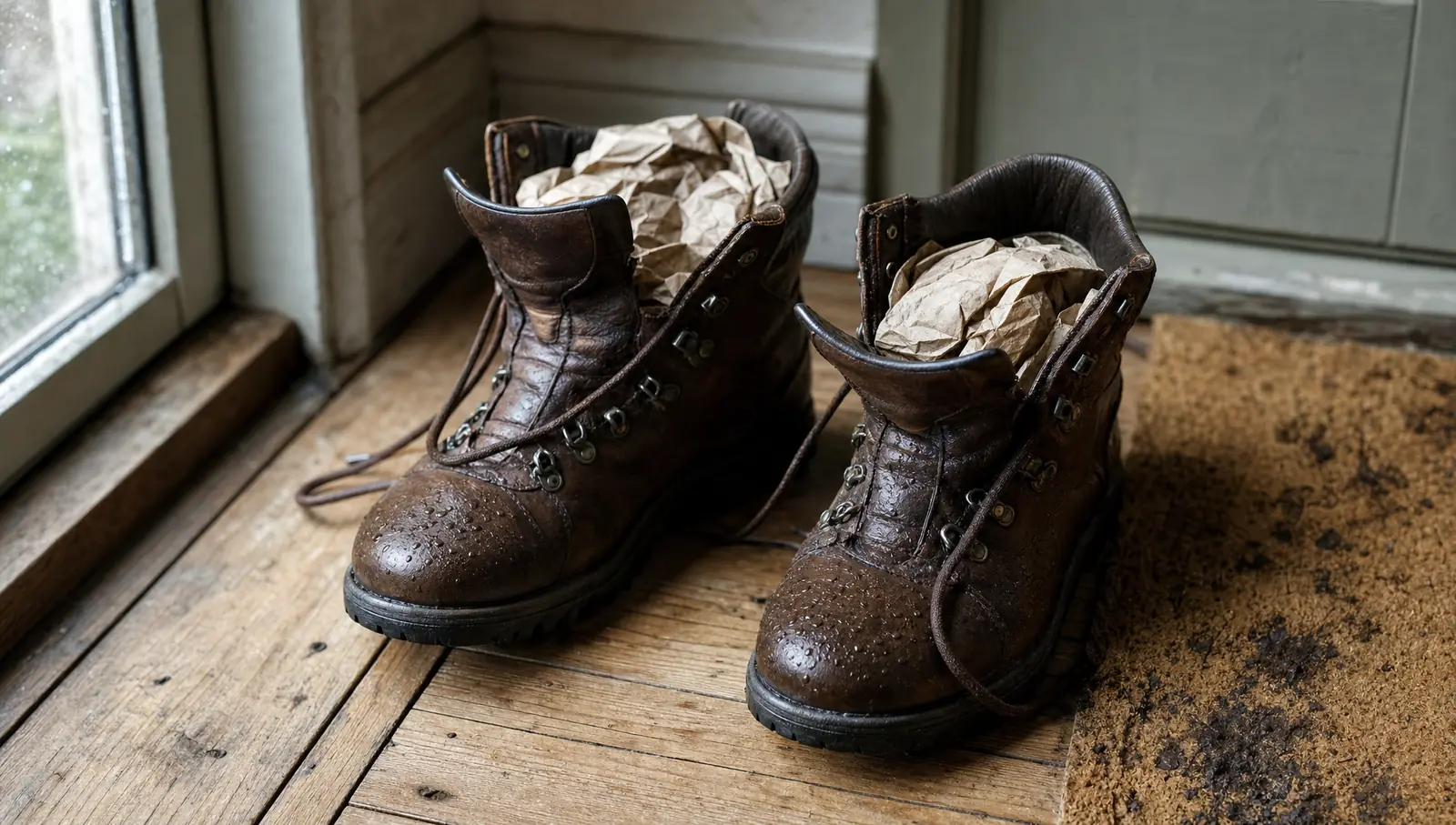
Drying wet boots without cooking them
Soaked leather wants a slow night, plain paper and moving air. Keep it away from the stove.
Leather boots that come home soaked have one job overnight, which is to dry slowly. The temptation after a wet day is to park them next to the wood stove or wedge them against a heater vent, and that is the fastest way to ruin a good pair. Heat pulls the oils out of leather, shrinks it, and can soften the glue that holds the sole to the upper. A boot cooked dry is often stiff, cracked at the flex point and a little smaller by morning.
Start at the door. Knock off the worst of the mud outside, then rinse what is left with a little cool water and a soft brush. Dried mud draws moisture out of leather as it dries and leaves it brittle, so the two minutes are worth it.
Next, open the boot up as far as it goes. Pull the laces loose all the way down, lift the tongue and take out the insoles. Insoles dry on their own in a few hours. Left inside, they hold a wet layer against the footbed that can take days to clear.
Then stuff the boots with paper. Newsprint, packing paper or paper towels all work. Crumple it loosely, push it into the toe and fill the boot to the top. The paper pulls water out of the lining. Swap it for dry paper after an hour or two, and again before bed. By the third change it comes out only damp.
Stand the boots somewhere with moving air and ordinary room temperature: a hallway, a mudroom, near a fan on a low setting. A boot dryer that blows room-temperature or barely warm air is fine. Anything that feels hot to your hand is too hot for the leather.
Give them time. A soaked leather boot usually needs a full day, sometimes two. Synthetic and mesh boots dry faster, often overnight, and tolerate a little more warmth, though the glue still dislikes heat.
Once they are dry, look them over. If the leather looks pale or feels tight, work in a thin coat of the conditioner made for that leather, and only after the boot is completely dry. Waterproofing treatments go on the same way. Wax applied over damp leather seals the water in.
A boot you have to wear again tomorrow is a different problem. In camp the same rules apply on a smaller scale. Open the boot, pull the insole, stuff it with a spare dry sock or a bandana and keep it well back from the fire. Put the insoles in your sleeping bag overnight. Wet boots on a cold morning are unpleasant, but they warm up within a mile, and they will still fit.